
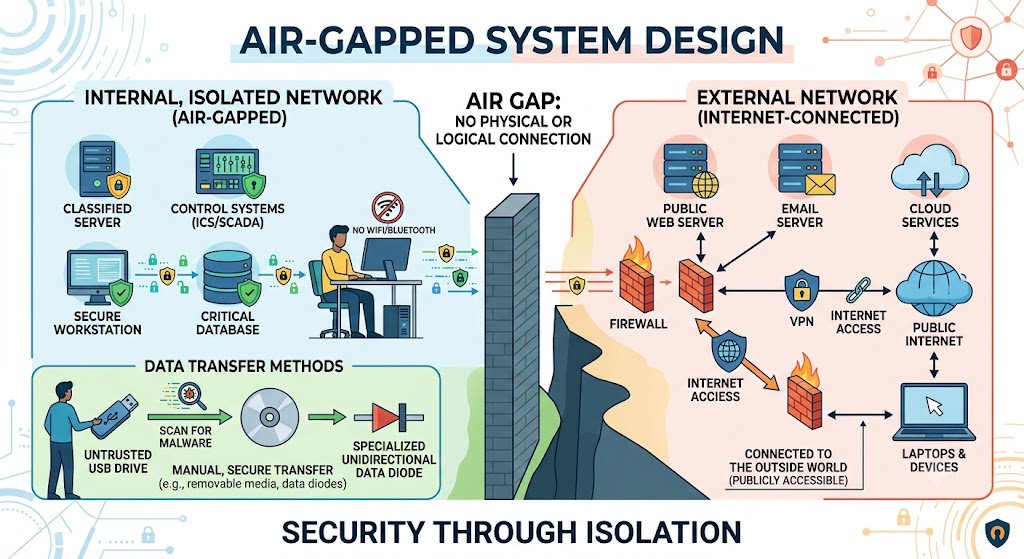
Artificial Intelligence adoption skyrocketed across enterprises, but so did the security risks. Data breaches, unauthorized access, and external vulnerabilities continue to plague cloud-based AI systems. Understanding what is air gap in cyber security has become critical for organizations handling sensitive information in 2026.
As a matter of fact, air-gapped AI solutions physically isolate systems from external networks, preventing data exfiltration while maintaining AI capabilities. These local AI deployments enable enterprises to leverage Artificial Intelligence without compromising security. Here are 11 air-gapped AI solutions designed to protect your most valuable data.
What Is Air Gap in Cyber Security: Definition and Core Principles
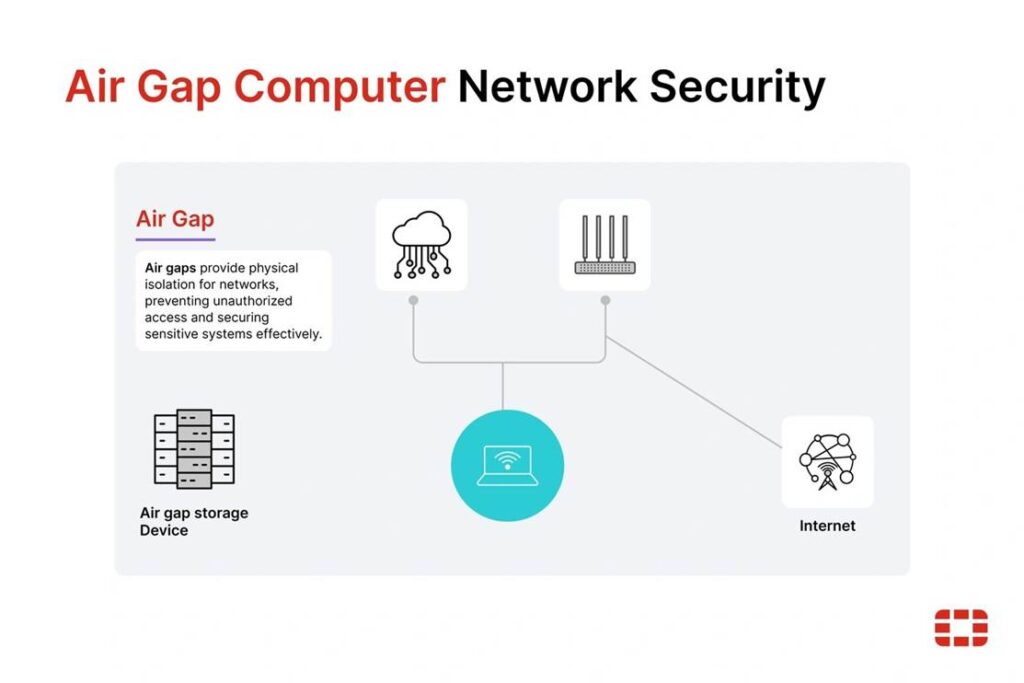
Image Source: Fortinet
Physical Isolation from External Networks
An air gap represents a security measure that physically isolates computer systems or networks from external connections [1]. NIST defines it as an interface where systems are not connected physically and any logical connection is not automated, requiring data transfer only manually under human control [2].
Physical separation means zero network interfaces connecting to external networks [1]. No ethernet cables, no wireless connections, and no direct digital pathways exist between the isolated system and outside networks [3]. Air-gapped computers have their wireless interface controllers either permanently disabled or physically removed [4].
How Air Gaps Prevent Unauthorized Access
Air gaps block network-based threats since malware infections, ransomware, and data breaches cannot reach systems that aren’t connected [3]. The isolation prevents malicious actors from infiltrating the secured environment remotely [1]. Data moves between the air-gapped system and other networks only through controlled, manual processes like removable storage devices [3].
However, vulnerabilities remain. Authorized personnel with physical access can potentially compromise the isolation through manual transfer processes used for legitimate operations [3].
Key Components of Air-Gapped Systems
Air gap security rests on three fundamentals: isolation, connectivity restriction, and controlled data flow [3]. Physical separation disconnects critical systems from vulnerable networks. Connectivity restriction severely limits or completely eliminates network access points. Controlled data flow ensures unidirectional transfers where data only moves into the air-gapped system through approved methods [3].
Why Enterprises Need Air-Gapped AI Solutions in 2026
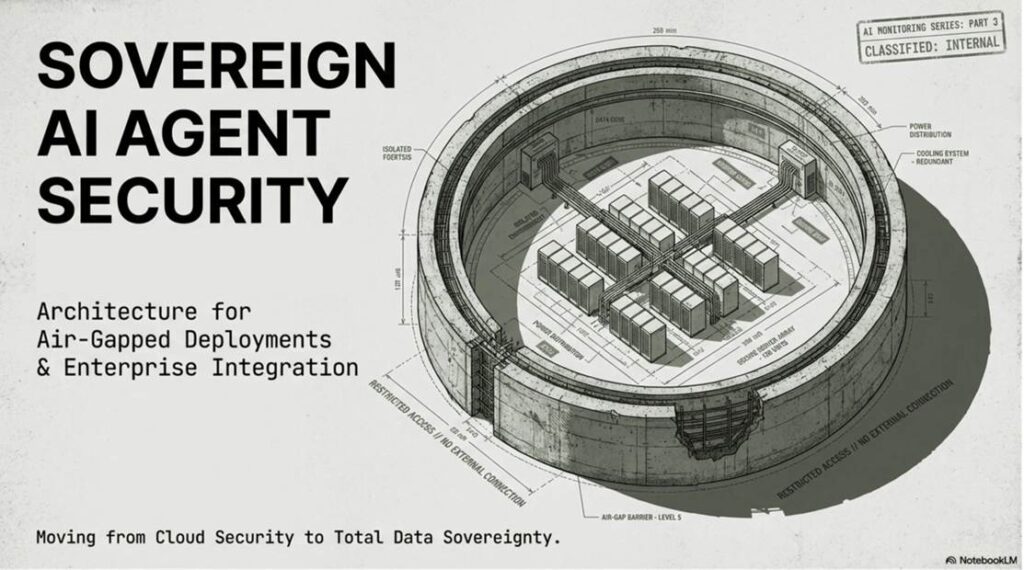
Image Source: Medium
Preventing Sensitive Data Leakage and Exfiltration
Cloud-based AI models pose significant risks through data exfiltration. Organizations transmit queries to external networks with minimal transparency about how information is logged, retained, or repurposed. Ransomware attacks remain a threat across 92% of industries [3], with the average ransomware breach costing USD 5.13 million, excluding ransom payments [3]. Ransom payments alone exceeded USD 1 billion in 2023 [3].
AI interactions amplify these risks. Research shows 39.7 percent of all AI interactions involve sensitive data [5]. Air-gapped AI solutions eliminate unauthorized data transfers by design, ensuring proprietary information physically cannot leave the secured environment [3].
Meeting Strict Compliance and Data Sovereignty Requirements
Regulatory frameworks enforce strict requirements for data processing and storage. The European Union’s GDPR mandates data minimization and requires personal data storage within approved jurisdictions [6]. Defense, intelligence operations, and critical infrastructure management demand impenetrable security under stringent operational security standards [6].
Air-gapped systems enable organizations to operate autonomously while ensuring compliance [6]. Google Distributed Cloud air-gapped meets technical requirements of ISO 27001/27017, SOC II, NIST, and achieves DoD Impact Level 6 authorization for Secret classified data [7].
Mitigating Cyber Threats and Supply Chain Vulnerabilities
Supply chain attacks and insider threats bypass traditional network defenses. Insider breaches cost an average of USD 4.92 million [7], while 51% of malware now targets USB devices [7]. Air gaps reduce attack surfaces by preventing external threat vectors from reaching critical systems [8].
Strategic Independence from Foreign AI Providers
Dependence on foreign-controlled AI systems increases strategic vulnerability. Cloud-based models from US and Chinese firms dominate the market, raising concerns for organizations managing critical infrastructure [6]. Air-gapped solutions allow enterprises to maintain technological autonomy and support broader initiatives toward self-determination [6].
Tabnine Enterprise (Self-Hosted)
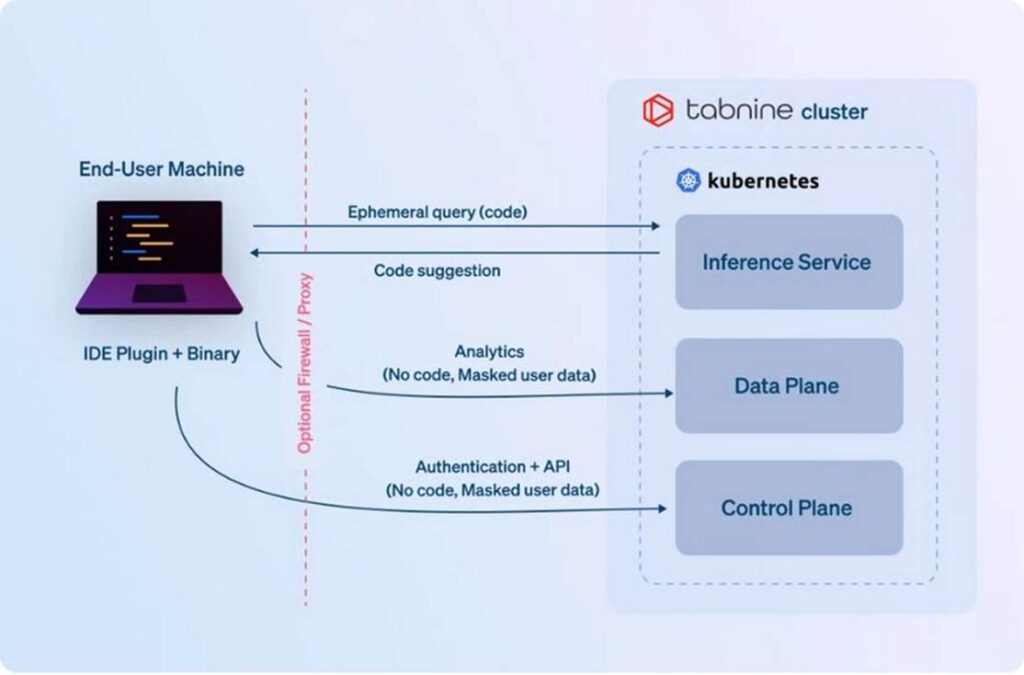
Image Source: Tabnine Docs
Key Features and Capabilities
Tabnine, operating since 2018, earned recognition as a Visionary in the September 2025 Gartner Magic Quadrant for AI Code Assistants [1]. The platform delivers code completion and AI chat capabilities across 600+ programming languages, libraries, and frameworks [1]. Built on large language models trained exclusively on permissively licensed open-source code, Tabnine provides contextual suggestions throughout the software development lifecycle [9].
The platform supports custom model integration, allowing enterprises to connect and fine-tune their own models or use Tabnine’s Universal code model [1]. Features extend beyond code generation to include test generation, code review, error fixing, documentation, and code explanation [1].
Deployment Requirements and Infrastructure
Tabnine Enterprise operates on Kubernetes clusters hosted either on-premises or within virtual private clouds on AWS, GCP, or Azure [1]. Organizations provide the infrastructure while Tabnine supplies helm charts for installation [1]. System requirements scale based on expected user count [10].
Air-Gapped Operation Support
The platform functions completely disconnected from external networks with zero telemetry or cloud dependencies [1]. All AI operations, including completions and chat, run locally using internally hosted models [1]. Tabnine meets SOC 2, ITAR, and CMMC requirements for defense contractors [1].
Pricing and Best For
Enterprise plans start at USD 39 per user monthly (annual billing) [1]. Suited for defense, banking, healthcare, and regulated industries requiring absolute data sovereignty [1].
Amazon Q Developer (Hybrid Deployment Options)
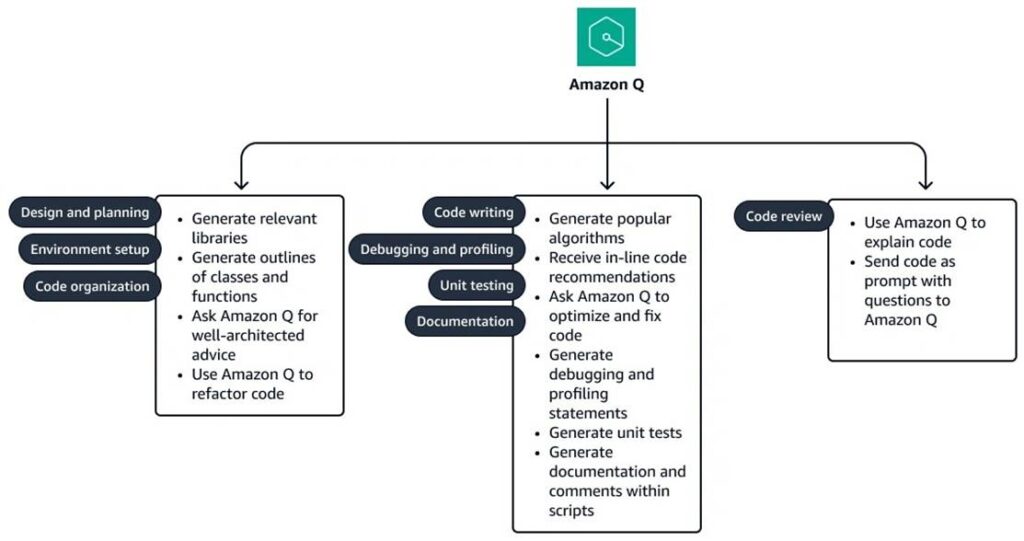
Image Source: AWS Documentation
Key Features and Capabilities
Amazon Q Developer accelerates software development across the entire lifecycle, from building and testing to deploying and optimizing applications [11]. Built on Amazon Bedrock, the platform delivers AI-powered code generation, inline suggestions spanning 25+ languages, security vulnerability scanning, and autonomous code transformation [12][13]. The system generates real-time code completions ranging from snippets to full functions based on comments and existing code patterns [11].
Workspace context awareness enables project-wide assistance tailored to development needs [13]. The platform handles Java upgrades, documentation generation, and automated code reviews detecting logical errors and security vulnerabilities [13]. Integration extends across VS Code, JetBrains, Visual Studio, and Eclipse IDEs, plus AWS Management Console and command line interfaces [11].
Deployment Requirements and Infrastructure
Amazon Q requires AWS account infrastructure with IAM Identity Center for Pro tier subscriptions [14]. Four deployment options exist: standalone accounts, management and member account combinations, member accounts only, or management accounts only [14]. Each configuration affects feature availability and administrative complexity. Clients must support TLS 1.2 or higher with cipher suites providing perfect forward secrecy [15].
Air-Gapped Operation Support
Amazon Q Developer operates exclusively in AWS regions and cannot be deployed on-premises or in air-gapped environments [16]. As a cloud-only service, it fundamentally conflicts with physical isolation requirements.
Pricing and Best For
Free tier provides 50 agentic requests monthly with 1,000 LOC transformations [11][3]. Pro tier costs USD 19.00 per user monthly, offering 1,000 agentic requests and 4,000 LOC transformations monthly [3][6]. Amazon Q achieved SOC 1, SOC 2, and SOC 3 certifications in December 2024 but is not HIPAA-eligible [16]. Suited for AWS-native development teams in non-healthcare regulated industries requiring cloud-based AI assistance.
Sourcegraph Cody (Enterprise Self-Hosted)
Image Source: Sourcegraph
Key Features and Capabilities
Sourcegraph Cody operates as an AI coding assistant using advanced LLMs combined with Sourcegraph’s Search API to pull context from local and remote codebases [8]. The platform delivers chat with AI models, code completions, auto-edit suggestions, and customizable prompts across VS Code, JetBrains, and Visual Studio [8]. Context filters prevent sensitive repositories from reaching third-party LLMs [17].
Cody became enterprise-only following the discontinuation of Free and Pro plans in July 2025 [18]. The platform maintains SOC 2 Type II and ISO 27001:2022 certifications [18], with zero-retention policies ensuring no code training on customer data [19].
Deployment Requirements and Infrastructure
Self-hosted Sourcegraph operates via Docker or Kubernetes clusters [5]. CPU and RAM handle indexing services, whereas GPU requirements depend on local model deployment [5]. Running local models through Ollama requires NVIDIA GPUs with 20GB+ VRAM (A100, H100, RTX 6000/8000) for 10-20B parameter models [5]. Enterprises need 10 Gbps internal networks minimizing latency for code completions [5].
Air-Gapped Operation Support
Air-gapped deployments run completely locally with internal model hosting [5]. Organizations requiring total data isolation deploy Sourcegraph Enterprise on-premises with bring-your-own-key model configuration [18].
Pricing and Best For
Enterprise pricing requires custom quotes, with minimums starting around USD 50,000-USD 75,000 annually [20]. Infrastructure adds USD 10,000-USD 50,000+ yearly [20]. Suited for Fortune 500 companies managing 300,000+ repositories requiring verified compliance certifications [18].
Qodo (CodiumAI Enterprise Platform)
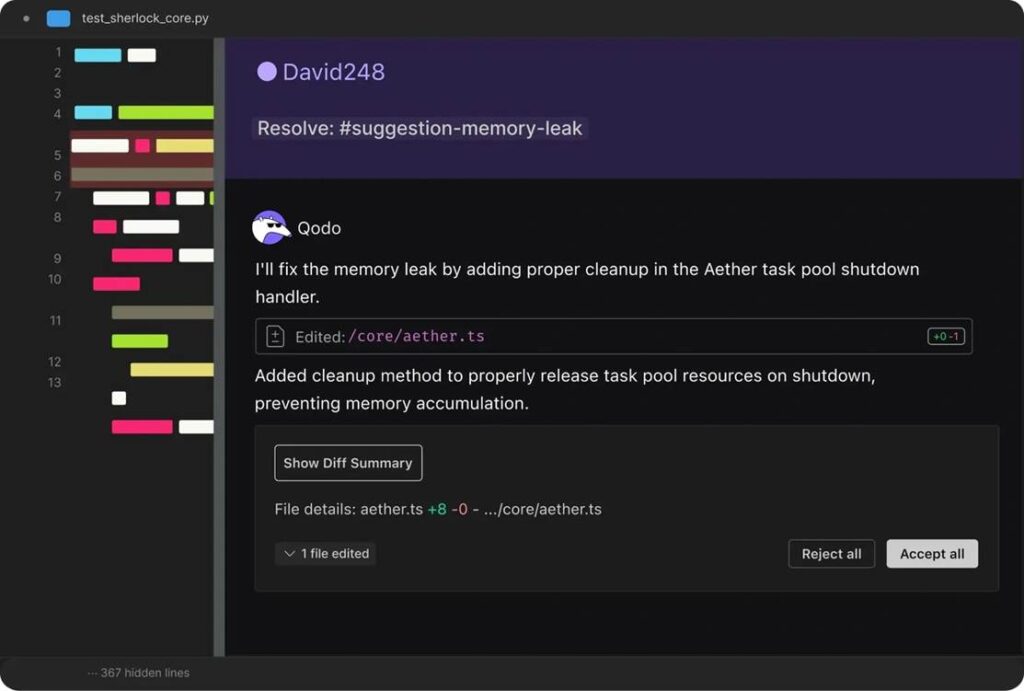
Image Source: www.qodo.ai
Key Features and Capabilities
Qodo, formerly CodiumAI, positions itself as a quality-first AI code review platform achieving an F1 score of 64.3% on the Code Review Bench, catching issues at nearly 2x the rate of competing solutions [7]. Gartner ranked Qodo #1 for code understanding in its Critical Capabilities for AI Assistants Report [7]. The platform catches an average of 800 bugs monthly across enterprise deployments [7].
The multi-agent review system analyzes pull requests from multiple perspectives using specialized review agents [21]. A proprietary context engine employs RAG techniques to index full codebases, pull request history, and organizational standards [22]. This enables context-aware code generation and reviews aligned with company-specific conventions [23].
Deployment Requirements and Infrastructure
Qodo requires Kubernetes version 1.24 or higher, supporting GKE, EKS, AKS, OpenShift, Rancher, and vanilla Kubernetes [24]. Component resource requirements vary: Qodo Git needs 1 CPU with 10Gi memory, Qodo IDE requires 4 CPU with 12Gi memory, while Indexer, Metadata Service, and Context Engine each need 500m CPU with 2Gi memory [24].
Air-Gapped Operation Support
The platform supports on-premises and air-gapped deployments with proprietary Qodo models self-hosted [25]. SOC 2 Type II certification provides independently audited security controls [7]. Zero data retention ensures code is analyzed and discarded without storage or model training [7].
Pricing and Best For
Enterprise pricing follows custom quotes [25]. Suited for Fortune 500 companies requiring quality-focused code review with complete data isolation [7].
GitHub Copilot Enterprise (Limited Air Gap Support)
Image Source: GitHub Docs
Key Features and Capabilities
GitHub Copilot Enterprise indexes organizational codebases for contextual understanding, delivers tailored suggestions, and provides access to fine-tuned custom private models [26]. The platform integrates chat directly into , enabling developers to query codebases in natural language GitHub.com[26]. Powered by models from GitHub, OpenAI, and Microsoft, the system trained on publicly available code [26]. Pull request summaries accelerate reviews while analyzing diffs to surface proposed changes [27].
Deployment Requirements and Infrastructure
GitHub Copilot Enterprise requires GitHub Enterprise Cloud as a mandatory prerequisite [28]. Each user needs both subscriptions, with Enterprise Cloud costing USD 21.00 per user monthly [28]. The platform enforces geographic data residency for organizations with compliance requirements [29].
Air-Gapped Operation Support
GitHub Copilot won’t work offline and requires GitHub login plus cloud connectivity [30]. In contrast to fully isolated solutions, the platform fundamentally conflicts with air gap principles. Organizations can configure secure proxy or bastion hosts authenticating with GitHub outside the air-gapped zone, then routing completions internally [30]. However, this approach isn’t possible in fully air-gapped environments [30].
Pricing and Best For
Enterprise costs USD 39.00 per user monthly, including 3,900 AI credits [31][32]. Combined with the required Enterprise Cloud subscription, total monthly cost reaches USD 60.00 per user. Suited for GitHub-native development teams accepting cloud dependencies over physical isolation.
MinIO AIStor for Air-Gapped AI Storage
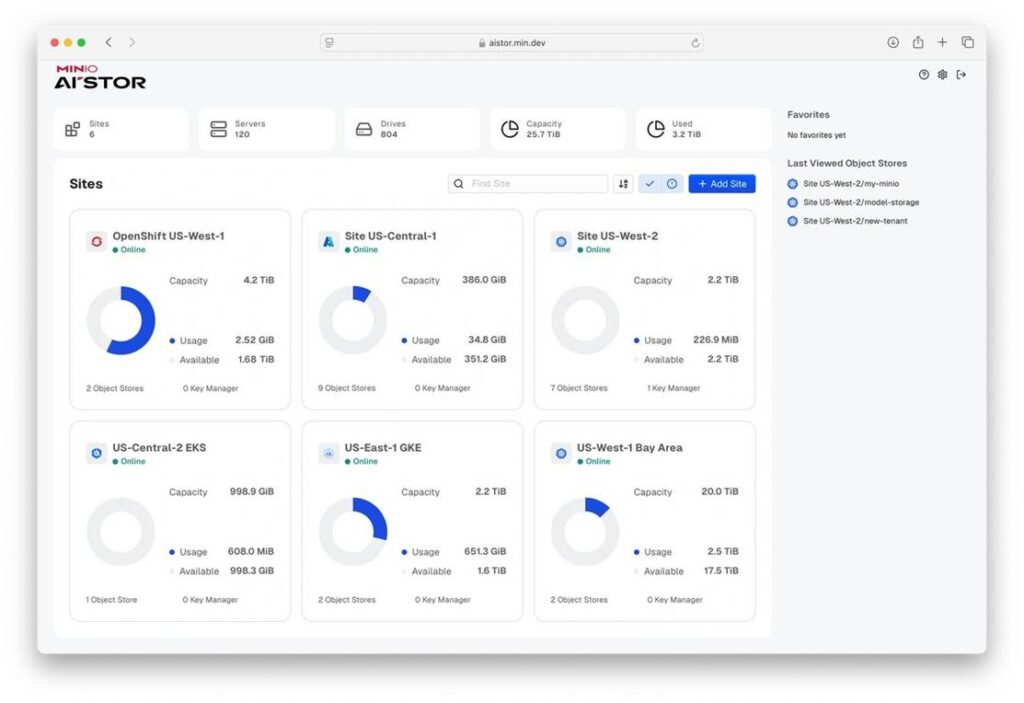
Image Source: MinIO
Key Features and Capabilities
MinIO AIStor delivers enterprise-grade object storage purpose-built for AI workloads requiring physical isolation [33]. The platform introduces AIHub, a private Hugging Face API-compatible repository enabling enterprises to store AI models and datasets in air-gapped environments without code changes [34]. The promptObject API extends S3 functionality, allowing applications to interact with unstructured objects using natural language prompts [35].
S3-compatible architecture scales to exabyte-class deployments with microsecond latency [36]. Features include encryption, object immutability, distributed caching, and comprehensive observability [37]. MinIO Catalog provides GraphQL-based metadata search across massive object stores [37].
Deployment Requirements and Infrastructure
Air-gapped deployment operates on Kubernetes clusters running version 1.24 or higher [38]. Organizations need private container registries accessible within isolated networks, Helm 3.17 or later, and Skopeo for image mirroring [38]. Network infrastructure requires 100GbE or higher bandwidth for optimal throughput [39].
Air-Gapped Operation Support
Installation follows a two-phase process: external preparation downloads Helm charts and copies container images to private registries, whereas airgapped deployment installs AIStor using mirrored resources [38]. All components pull from internal registries, ensuring zero external connectivity [38].
Pricing and Best For
AIStor costs USD 0.02 per GB monthly (USD 20 per TB) [37]. Three tiers exist: Free for development, Enterprise Lite for smaller production environments, and Enterprise with direct-to-engineer support [40]. Suited for organizations requiring sovereign AI infrastructure with complete data isolation.
Squirro On-Premise AI Platform
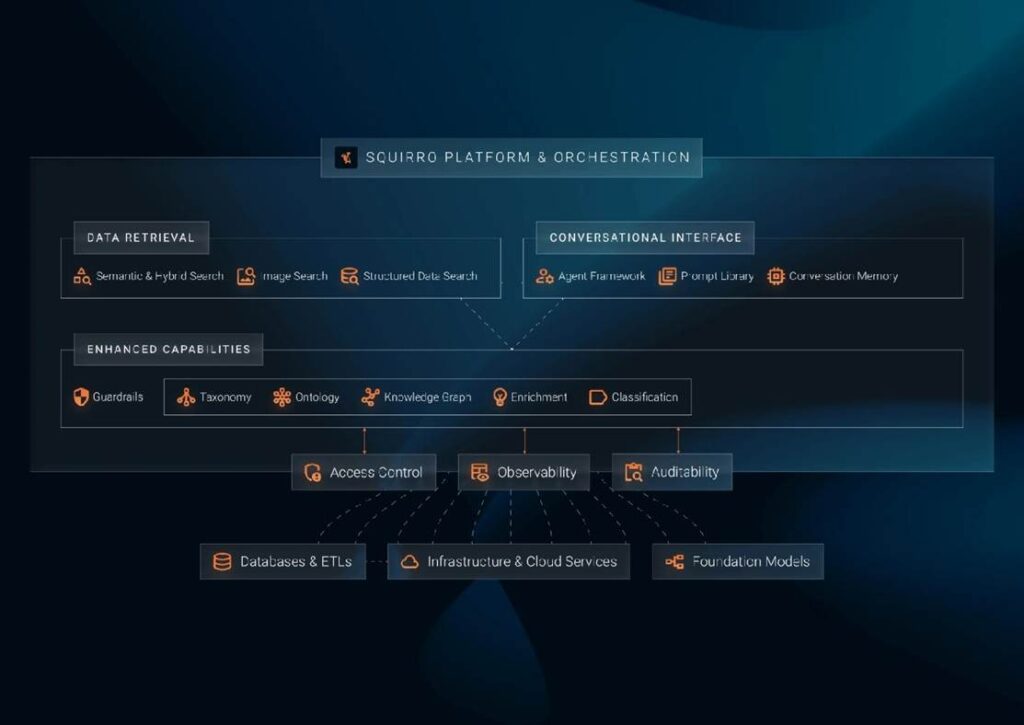
Image Source: Squirro
Key Features and Capabilities
Squirro functions as an infrastructure-agnostic GenAI platform serving as a secure integration layer rather than providing LLMs directly [41]. The system allows enterprises to deploy any model on on-premises hardware or within secure VPCs, connecting to local LLM endpoints via internal networks [41]. Notably, Squirro has been mentioned in 25 Gartner reports in 2025 and stands as the only European vendor named as a Leader in Gartner’s 2025 EMQs for Gen AI Engineering and AI Knowledge Management Apps [10].
The platform enforces granular access controls through RBAC/ABAC, automated PII masking, and AI Guardrails within an ISO 27001 certified framework [42]. RAG technology and semantic search capabilities enable knowledge unification across disparate data sources [43]. All actions receive audit logging for compliance tracking [42].
Deployment Requirements and Infrastructure
Squirro deploys entirely on customer hardware behind corporate firewalls [10]. The platform requires LLMs supporting OpenAI API specifications and tool calling capability [44]. Organizations maintain complete control over LLM infrastructure while Squirro orchestrates agent execution and API communication [44].
Air-Gapped Operation Support
The platform installs in fully offline, air-gapped networks without internet access [42]. Core functionality operates independently of external cloud services, with all AI models residing on customer infrastructure [42]. A national financial institution achieved 100% data sovereignty running Squirro entirely on-premises [10].
Pricing and Best For
Squirro offers user-based and platform-based pricing models [45]. Suited for government, banking, and defense sectors requiring absolute data sovereignty [42].
Llama 3 with Local Deployment
Image Source: Meta AI
Key Features and Capabilities
Meta released Llama 3 as an open-source large language model available in 8B and 70B parameter configurations [1]. Both models support 8,192 token context windows, doubling Llama 2’s capacity [46]. Training data expanded to 15 trillion tokens, seven times more than the previous generation, with quadrupled code representation [46]. The tokenizer delivers 15% improved efficiency compared to Llama 2 [1]. Group Query Attention maintains inference speed despite the 8B model containing 1 billion additional parameters [1].
Performance benchmarks show Llama 3 8B outperforming Llama 2 70B in certain scenarios with a 10% relative improvement at equivalent parameter scales [46]. The transformer-based architecture handles text completion, translation, and question-answering tasks matching GPT-4 capabilities [46].
Deployment Requirements and Infrastructure
Llama 3 8B requires 16GB disk space and 20GB VRAM in FP16 format [47]. The 70B model demands 140GB disk space with 160GB VRAM [47]. Deployment tools include Ollama for simplified setup, llama.cpp for optimized CPU inference, vLLM for production throughput, and TensorRT-LLM for maximum NVIDIA GPU performance [9].
Air-Gapped Operation Support
Model weights transfer via physical media following chain-of-custody procedures [9]. Inference servers operate without internet connectivity, ensuring data never reaches external systems [9].
Pricing and Best For
Free open-source license. Suited for organizations requiring sovereign AI without licensing costs.
Mistral AI Open-Weight Models
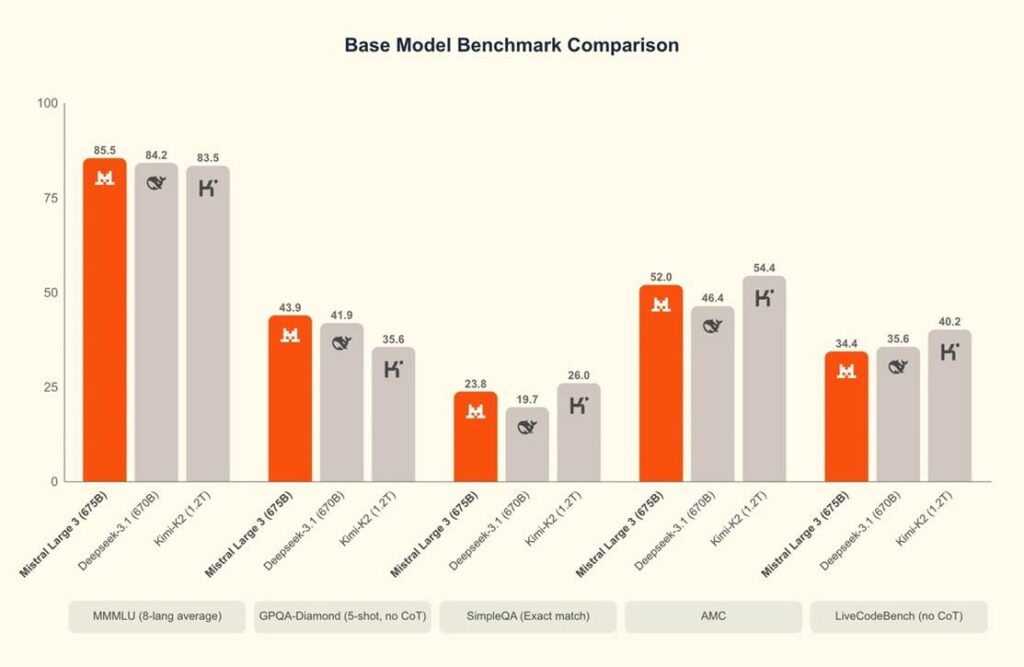
Image Source: Mistral
Key Features and Capabilities
Mistral provides open-weight models deployable on customer infrastructure, offering transparency and control absent from proprietary alternatives [48]. The portfolio spans multiple architectures: Mistral Large 3 operates as a mixture-of-experts model using 41B active parameters from 675B total [49], whereas Mistral Medium 3.5 delivers 128B parameters optimized for agentic workflows [50]. The Ministral 3 series (3B, 8B, 14B) targets edge deployments with multimodal capabilities [49].
All major models carry Apache 2.0 licenses, permitting commercial deployment without restrictive terms [49]. Fine-tuning on internal datasets occurs without external data retention, directly addressing sovereignty requirements for finance, healthcare, and public administration sectors [48].
Deployment Requirements and Infrastructure
Self-deployment operates through vLLM, TensorRT-LLM, or TGI inference engines [51]. Full-precision inference for 128B models requires 4-8 high-memory GPUs (A100 80GB equivalent), whereas quantized versions reduce requirements to 2-4 GPUs [50].
Air-Gapped Operation Support
Models run entirely on private infrastructure with zero cloud dependencies [48]. Organizations download weights via physical transfer, then execute inference locally without internet connectivity [52][53].
Pricing and Best For
Open models carry no licensing fees. Hosted API pricing ranges from USD 0.10-USD 2.00 per million input tokens [54]. Suited for enterprises requiring transparent AI with complete data sovereignty [48].
Alibaba Qwen for Air-Gapped Environments
Image Source: Alibaba Cloud
Key Features and Capabilities
Alibaba Cloud released Qwen3 in April 2025 under Apache 2.0 licensing, offering models ranging from 0.6B to 235B parameters [55]. The family includes dense models (0.6B, 1.7B, 4B, 8B, 14B, 32B) and mixture-of-experts variants like 30B-A3B and 235B-A22B [55]. Training occurred across 36 trillion tokens in 119 languages and dialects [55]. Qwen 3.5, the latest iteration, operates with 397 billion parameters while activating only 17 billion per forward pass, reducing operational costs by 60% and boosting efficiency eightfold [56].
Deployment Requirements and Infrastructure
Self-hosting operates through vLLM or SGLang frameworks with specific GPU requirements [57]. The Qwen3-32B model needs a single H100 80GB GPU running FP8 quantization, consuming approximately 37-38GB at runtime [58]. Predibase enables VPC deployment across AWS, GCP, and Azure with complete infrastructure control [59]. The 8B variant runs on RTX 4090 GPUs, whereas the 235B-A22B MoE requires 4-8 H100 GPUs [58].
Air-Gapped Operation Support
All Qwen3 models carry Apache 2.0 open-weight licensing available through Hugging Face, enabling self-hosting at USD 0.00 per token [57]. Organizations transfer model weights via physical media, then execute inference without internet connectivity, resolving data residency concerns entirely [57].
Pricing and Best For
Self-hosting eliminates API costs. Alibaba’s paid API carries ISO 27001 certification but requires cloud connectivity [57]. Suited for organizations processing sensitive data in jurisdictions where China-origin cloud compliance matters.
Hugging Face Transformers Self-Hosted Solutions
Image Source: Hugging Face
Key Features and Capabilities
The open-source Transformers library provides APIs and tools for downloading state-of-the-art pre-trained models across natural language processing, computer vision, audio, and multi-modal applications [60]. As of January 2026, the Hub hosts over 2.4 million models covering text classification, translation, segmentation, speech recognition, and object detection [11]. The Datasets Library contains over 730,000 datasets accessible through simple code implementations [11].
Transformers pipelines encode best practices with default models selected for different tasks, supporting GPU batching for improved throughput [60]. The Optimum library extends Transformers by adding hardware-specific optimizations for training and inference, providing quantization tools and graph optimizations for accelerators including NVIDIA TensorRT, Intel Gaudi, and AWS Trainum [11].
Deployment Requirements and Infrastructure
Databricks Runtime includes Hugging Face transformers in version 10.4 LTS ML and above [60]. Organizations can install via PyPI with dependencies like librosa for audio decoding, SentencePiece for tokenization, and bitsandbytes for 8-bit quantization [60].
Air-Gapped Operation Support
NVIDIA NIM supports serving models in air-gapped systems with no internet connection and no access to NGC registry or Hugging Face Hub [61]. Organizations download models to local cache, then run vLLM with the HF_HUB_OFFLINE=1 environment variable set, pointing directly to local directories rather than model names [62].
Pricing and Best For
The Hub remains free for accessing models and datasets. Enterprise plans provide custom infrastructure, advanced security controls, and private on-premises deployments [11]. Suited for organizations requiring flexible AI deployment with complete ecosystem access.
Conclusion
Air-gapped AI solutions address critical security gaps that cloud-based systems simply cannot resolve. With this in mind, organizations handling sensitive data now have clear paths forward. The choice depends on specific requirements: commercial platforms like Tabnine and Sourcegraph deliver turnkey implementations, whereas open-source models like Llama 3 and Mistral provide cost-effective sovereignty without licensing constraints.
Although implementing air-gapped infrastructure requires upfront investment, the protection against data breaches averaging USD 5.13 million justifies the deployment complexity. Start by identifying your compliance requirements, then evaluate solutions matching your technical capabilities. Defense contractors and financial institutions benefit from certified platforms, whereas research organizations may prefer flexible open-source alternatives. Ultimately, air gaps represent insurance against threats that network security alone cannot prevent.
References
[1] – https://ai.meta.com/blog/meta-llama-3/
[2] – https://csrc.nist.gov/glossary/term/air_gap
[3] – https://aws.amazon.com/q/developer/pricing/
[4] – https://en.wikipedia.org/wiki/Air_gap_(networking)
[5] – https://intuitionlabs.ai/articles/enterprise-ai-code-assistants-air-gapped-environments
[6] – https://www.superblocks.com/blog/amazon-qdeveloper-pricing
[7] – https://www.qodo.ai/
[8] – https://sourcegraph.com/docs/cody
[9] – https://www.llama.com/docs/deployment/regulated-industry-self-hosting/
[10] – https://squirro.com/on-premises-enterprise-ai
[11] – https://research.contrary.com/report/hugging-face
[12] – https://docs.aws.amazon.com/amazonq/latest/qdeveloper-ug/what-is.html
[13] – https://aws.amazon.com/q/developer/features/
[14] – https://docs.aws.amazon.com/amazonq/latest/qdeveloper-ug/deployment-options.html
[15] – https://docs.aws.amazon.com/amazonq/latest/qdeveloper-ug/infrastructure-security.html
[16] – https://www.augmentcode.com/tools/gitlab-duo-vs-amazon-q-devsecops-alignment-and-compliance
[17] – https://sourcegraph.com/blog/cody-enterprise-june-2024
[18] – https://www.augmentcode.com/tools/sourcegraph-cody-vs-continue-enterprise-comparison
[19] – https://sourcegraph.com/terms/cody-notice
[20] – https://www.vendr.com/marketplace/sourcegraph
[21] – https://docs.qodo.ai/code-review
[24] – https://docs.qodo.ai/on-prem/qodo-on-premise/infrastructure-requirements
[25] – https://www.qodo.ai/pricing/
[26] – https://github.com/features/copilot/plans
[27] – https://github.blog/news-insights/product-news/github-copilot-enterprise-is-now-generally-available/
[28] – https://github.com/orgs/community/discussions/178834
[29] – https://docs.github.com/en/enterprise-cloud@latest/copilot/get-started/what-is-github-copilot
[30] – https://github.com/orgs/community/discussions/173463
[31] – https://docs.github.com/enterprise-cloud@latest/copilot/get-started/choose-enterprise-plan
[32] – https://docs.github.com/en/copilot/get-started/plans
[33] – https://www.min.io/learn/air-gap
[34] – https://thenewstack.io/minio-unveils-aistor-a-potential-object-storage-game-changer/
[36] – https://www.min.io/product/aistor
[37] – https://www.min.io/blog/aistor-overview
[38] – https://docs.min.io/aistor/installation/kubernetes/install/deploy-aistor-airgap/
[39] – https://docs.min.io/aistor/reference/aistor-server/requirements/network/
[40] – https://www.min.io/press/minio-introduces-aistor-free-and-enterprise-lite-tiers
[41] – https://squirro.com/squirro-blog/air-gapped-ai-offline-ai
[42] – https://squirro.com/industries/government
[43] – https://www.getapp.com/business-intelligence-analytics-software/a/squirro-customer-insights/
[44] – https://docs.squirro.com/en/latest/technical/agents/llm-support.html
[45] – https://www.gartner.com/reviews/product/squirro-enterprise-genai-platform
[48] – https://agatsoftware.com/blog/private-ai-deployment-with-mistral-explained/
[49] – https://mistral.ai/news/mistral-3/
[50] – https://www.mindstudio.ai/blog/what-is-mistral-medium-3-5-open-weight-agent-model/
[51] – https://docs.mistral.ai/models/deployment/local-deployment
[53] – https://dspace.mit.edu/bitstream/handle/1721.1/164901/MIT-LIN-151372.pdf?sequence=1&isAllowed=y
[54] – https://mistral.ai/pricing/
[55] – https://en.wikipedia.org/wiki/Qwen
[56] – https://mlq.ai/news/alibaba-launches-qwen-35-ai-model-with-superior-efficiency-and-agentic-features/
[57] – https://www.eesel.ai/blog/qwen-pricing
[58] – https://www.spheron.network/blog/deploy-qwen3-gpu-cloud/
[59] – https://www.rubrik.com/blog/ai/25/how-to-deploy-and-serve-qwen-3-in-your-private-cloud-vpc
[60] – https://learn.microsoft.com/en-us/azure/databricks/machine-learning/train-model/huggingface/
[61] – https://docs.nvidia.com/nim-operator/latest/air-gap.html
[62] –https://discuss.vllm.ai/t/setting-up-vllm-in-an-airgapped-environment/916

Comments are closed