
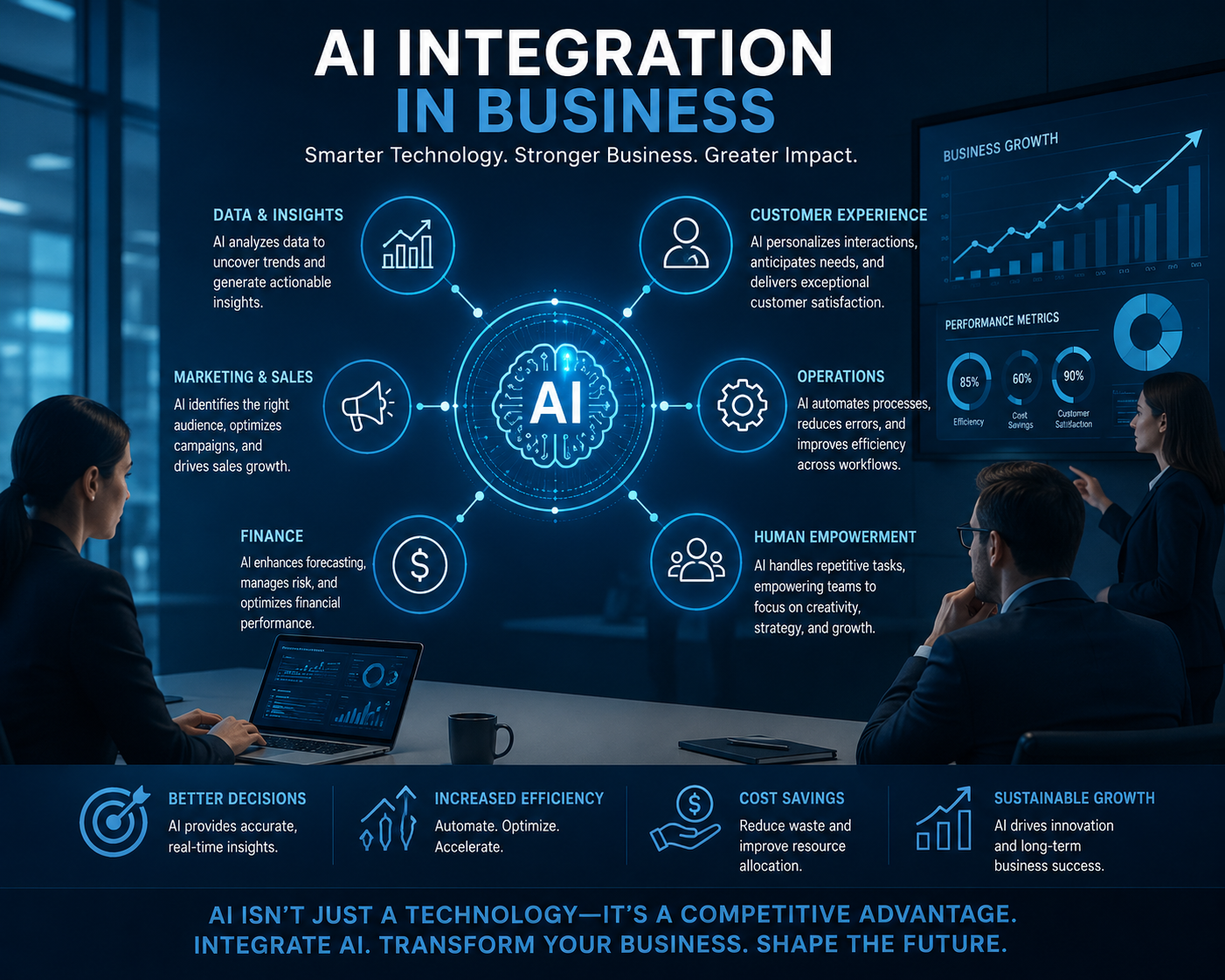
Many organizations rush into AI implementation only to watch their projects stall or fail entirely. The excitement around artificial intelligence is real, but turning that potential into tangible business value requires more than enthusiasm.
The difference between successful and failed AI projects? A structured, strategic approach that addresses everything from infrastructure readiness to team training.
This guide walks you through each critical phase of AI implementation. You’ll learn how to assess your organization’s readiness, build a winning strategy, execute pilot programs, and scale initiatives that deliver measurable ROI.
Understand AI Implementation Basics
What AI Implementation Means for Your Business
AI implementation goes beyond installing software or adopting new tools. It represents a fundamental shift in how your organization processes information, makes decisions, and serves customers. At its core, AI implementation involves integrating artificial intelligence technologies into existing business processes and workflows to solve specific problems or capture opportunities.
The term “AI” encompasses a broad spectrum of technologies. ChatGPT-style chatbots, robotics systems, and predictive analytics all fall under this umbrella, and the field continues to evolve rapidly. This diversity means every organization sits at a different point in their AI journey, with unique capabilities and distinct business objectives.
No universal template exists for AI implementation. However, certain best practices apply regardless of which direction the technology evolves or which path your organization takes. Successful AI implementations follow critical steps that remain constant across use cases.
Key Components of Successful AI Integration
Four fundamental technologies form the backbone of most AI implementations:
Machine learning algorithms analyze input data to make predictions or classifications. These algorithms learn from training datasets to identify patterns, detect anomalies, and generate projections such as sales revenue forecasts. They excel at mining large datasets for insights that drive better business decisions.
Deep learning enables task automation without human intervention. Virtual assistants, facial recognition systems, and fraud prevention tools all rely on deep learning models. These systems examine user behavior data to predict future actions. Compared to standard machine learning, deep learning extracts information from unstructured data like text and images with greater accuracy and less human oversight.
Natural language processing allows computers to recognize, understand, and generate text and speech. Customer support chatbots, digital assistants, and GPS systems all run on NLP. Combined with machine learning and deep learning, NLP extracts insights from text-based or voice-driven unstructured data.
Computer vision extracts information from digital images, videos, and visual inputs. Using deep learning and machine learning algorithms, computer vision systems learn to identify specific elements within digital imagery.
Beyond technology selection, organizations must consider the infrastructure supporting their AI systems. Cloud service providers offer flexible solutions for processing and storage needs, particularly for companies lacking extensive on-premises resources. Open-source libraries like Scikit-Learn and Keras provide prebuilt algorithms and model architectures that reduce development time.
Common AI Implementation Models
An AI operating model defines how your organization structures, governs, and deploys artificial intelligence throughout business processes. It encompasses the people, processes, technology, and data management practices that enable AI initiatives to succeed.
Organizations typically choose between centralized and decentralized structures. Successful companies often establish dedicated AI steering groups or integrate AI strategy discussions into leadership meetings to drive alignment and accountability. Companies experiencing high ROI from AI use a targeted approach, focusing on around 3.5 key use cases compared to 6.1 for less successful companies [1].
The value of these operating models stems from their ability to focus AI investments on strategic, high-impact areas rather than spreading efforts thin. A strong model ensures investments align with business goals and target transformation over incremental improvements. This structured approach increases the likelihood of realizing substantial financial benefits from AI initiatives.
Assess Your Organization’s Readiness
Before launching any AI initiative, you must determine whether your organization possesses the foundational elements required for success. AI readiness assessments measure preparedness across seven key pillars: Business Strategy, AI Governance & Security, Data Foundations, AI Strategy & Experience, Organization & Culture, Infrastructure for AI, and Model Management [2].
Evaluate Your Current Data Infrastructure
Your data infrastructure determines whether AI projects will thrive or fail. Only 29% of technology leaders strongly agree that their enterprise data meets the quality, accessibility, and security standards needed to efficiently scale generative AI [3]. This gap stems from data sprawl, fragmentation, poor quality, and governance risks that plague modern data ecosystems.
Start by conducting a thorough data audit. Catalog all data sources, including legacy systems, cloud storage, spreadsheets, and unauthorized sources. Assess quality across six dimensions: accuracy, completeness, consistency, timeliness, uniqueness, and validity. Use profiling techniques to uncover anomalies, duplicates, or missing values. Map how data flows through your organization during collection, storage, processing, and maintenance phases.
AI-ready data must be representative of every pattern, error, outlier, and unexpected emergence needed to train or run an AI model for specific use cases [4]. Evaluate data readiness across five critical dimensions: data availability, volume and diversity, quality and integrity, governance, and data ethics and responsibility [5]. According to Gartner, 80% of digital organizations risk failure without modern data governance [6]. Despite 68% of enterprises allocating nearly 30% of their IT budgets to data management, only 12% achieve AI maturity [6].
Address compliance requirements early. Identify regulations that apply to your organization, such as HIPAA, SOX, GLBA, or CCPA. Review data retention and deletion policies to ensure they meet regulatory standards. Document compliance gaps and create a remediation plan with clear timelines and responsibilities.
Identify Skill Gaps in Your Team
Human expertise remains critical for AI implementation, yet rapid technological advancement widens the AI skills gap. The gap represents the distance between what employees can do with AI tools and what organizations need them to do [7]. McKinsey projects that up to 30% of total worked hours could be automated by 2030 [7].
Conduct a comprehensive AI maturity assessment to measure your organization’s data analytics capabilities, current employees and skill sets, technology and infrastructure, and overall strategic vision [8]. Test the AI readiness of current employees in relevant AI topics to identify gaps in skill proficiency [9].
Use a role-by-capability matrix that maps business-critical functions against the AI skills each role actually needs. Run baseline assessments to measure current capability levels across teams. Skills audits combined with leader input reveal where gaps create the most business risk [7]. Organizations that embed AI into performance reviews and learning objectives are 2.5 times more likely to report measurable ROI from AI projects [7].
Determine High-Impact Areas for AI
Focus on common workplace challenges in three key areas: repetitive low-value tasks, skill bottlenecks, and navigating ambiguity [10]. Ask teams to list scenarios where they spend time on manual work that others don’t appreciate or value, wait for input from specialized experts, or need to synthesize information quickly to make decisions.
Companies experiencing high ROI from AI use a targeted approach, focusing on around 3.5 key use cases compared to 6.1 for less successful companies. Evaluate and prioritize opportunities based on business impact and implementation effort. Promote this prioritization framework company-wide to identify the best ideas [10].
Set Clear Goals and Success Metrics
Develop SMART goals (Specific, Measurable, Achievable, Relevant, and Time-bound) that guide the AI implementation journey [11]. Align AI initiatives with business targets before deployment. Technology serves as a tool for achieving goals, not a goal itself [12].
Track critical metrics including return on investment, adoption rates, customer experience scores, time-to-value, model accuracy and efficiency, and operational efficiency metrics [12]. Align data governance frameworks and capabilities with specific KPIs such as customer lifetime value, new recurring revenue, and employee experience [13]. Data governance should identify and label the data that both describes performance and informs performance measurement.
Build Your AI Implementation Strategy
Once you’ve assessed organizational readiness, the next phase focuses on translating that understanding into actionable strategy. AI implementation planning defines how initiatives move from intent to adoption across data, systems, teams, and governance.
Choose the Right AI Technologies and Tools
A single AI solution cannot fulfill all organizational needs. Organizations must prioritize specialized, fit-for-purpose AI tools with robust integration capabilities. Before evaluating features, confirm compatibility with your existing tech stack, including CRM platforms, project management systems, and Microsoft 365 workspace.
Evaluate build versus buy tradeoffs honestly. When selecting vendors, prioritize integration capabilities, data privacy practices, quality of support, and total cost of ownership over flashy demos. Check for comprehensive documentation, support for various data formats, and API availability for seamless workflow integration.
Security and compliance remain non-negotiable. Any AI tool processing business data must meet regulatory requirements before deployment. Verify where data is stored, whether inputs train AI models, who has access under vendor agreements, and whether tools meet industry-specific standards. Involve IT early to prevent costly rework and security gaps after deployment. While 72% of organizations now measure AI return on investment, success only materializes when tools connect to defined use cases [14].
Assemble Your AI Team
Executive leadership support determines whether AI projects succeed or fail. A C-suite sponsor ensures AI initiatives align with company strategy, secures startup funding, and acts as project director.
Technical roles form the implementation backbone. Systems architects operationalize machine learning models within existing IT frameworks. Data engineers define and implement data integration into the AI architecture. Data scientists explore data to extract actionable business information. DevOps engineers ensure solutions roll out and operate smoothly.
Business analysts translate between technical teams and business users, working with departments to understand needs and guiding machine learning work accordingly. Domain experts provide industry context so AI solutions address meaningful problems. An AI ethics and compliance officer ensures solutions meet ethical standards and regulatory requirements.
Create a Phased Deployment Plan
Build a scalable deployment plan by identifying implementation roadmaps for high-priority initiatives. AI requires various roles, capabilities, and technologies to work together harmoniously. Position your deployment plan as a collectively owned artifact focused on sharing, enabling, and continuously improving.
Start small but intentionally. Gartner estimates that at least 30% of generative AI projects will be abandoned after proof of concept by the end of 2025, driven by poor data quality, inadequate risk controls, escalating costs, or unclear business value [15]. Your roadmap should describe how AI becomes part of execution over time, not how fast you can deploy it.
Structure implementation in phases with clear checkpoints. Each phase builds on the previous one, creating decision points that reduce risk while enabling measurable progress. Define dependencies, escalation paths, and success metrics that reflect operational impact.
Address Budget and Resource Allocation
AI budgeting presents unique challenges. Research into ROI varies enormously, from 5% to 350% [16]. CFOs report it feels like hitting a moving target while blindfolded, particularly given that 59% of companies plan to increase AI rollout or investment [16].
Start by aligning AI projects with business goals such as efficiency, growth, and competitiveness. Take an exploratory, iterative approach rather than forecasting every possible application upfront. Allocate a general fund for experimentation with a fundamental framework attached.
Factor data management into cost-benefit analysis. Budget for cleaning, normalizing, and cataloging data ready for AI processing, plus continuous maintenance and storage. Account for soft costs including training, change management, and user adoption. Finding skilled AI engineers and data scientists capable of overseeing projects takes time and money. Cloud-based solutions like AWS or Oracle Cloud Infrastructure allow you to pay for what you use, shifting from capital expenditures to operational expenditures.
Establish Governance and Ethical Guidelines
Trustworthy AI should be lawful, ethical, and robust [1]. AI governance encompasses frameworks, policies, and practices that guide how organizations develop, deploy, and manage AI systems.
Seven key requirements form the foundation: human agency and oversight, technical robustness and safety, privacy and data governance, transparency, diversity and non-discrimination, societal and environmental well-being, and accountability [1].
Establish clear ownership for AI systems. Every model or application should have accountable individuals responsible for outcomes, risk management, and compliance with internal policies. Create unified access controls to prevent shadow AI, where models deploy outside formal oversight.
Governance must be cross-functional, involving data and AI teams, legal and compliance, privacy and security, and business stakeholders. Define specific policies for AI development and usage, establish consistent decision-making frameworks for ethical dilemmas, and regularly review guidelines as AI develops. Organizations should designate specific individuals responsible for each element of an AI tool, ensuring governance has teeth with real consequences.
Execute Your AI Projects
With strategy established, execution transforms plans into operational reality. This phase requires disciplined focus on pilot testing, team enablement, workflow integration, and performance tracking.
Start with Pilot Programs
Well-designed pilots deliver defensible decisions in four to eight weeks at minimum cost [17]. Focus on one use case, one dataset, and one measurable question. Set success thresholds before seeing results, defining what accuracy level constitutes a pass and maximum acceptable latency for the use case [17]. Map technical metrics to business outcomes: accuracy to first-contact resolution rate, latency to user adoption, cost-per-query to cost-per-transaction saved [17].
Train Your Team on AI Tools
Training requires more than generic courses. Create small communities of learning where employees experiment under guidance from experienced peers [18]. Teach the six-step prompting framework: establish persona, list task, provide context, identify audience, describe goal, and specify output format [18]. Use a red-yellow-green scale that defines appropriate and responsible tool usage [18].
Integrate AI into Existing Workflows
Identify high-impact workflows where repetitive work requires intelligence and nuance [19]. Check data quality and compliance before integration. Test rigorously in controlled environments before company-wide rollout [20].
Monitor Performance and Gather Feedback
Track response time, customer satisfaction scores, and issue resolution rates [21]. Use both real-time monitoring for instant alerts and historical monitoring to catch model drift [22]. Establish feedback loops where insights lead to specific actions and track outcomes [21].
Scale and Optimize AI Initiatives
Successful pilots prove concept viability, but true business transformation requires enterprise-wide deployment. Only 11% of companies have adopted generative AI at scale [23], yet those reaching the ‘realizing’ stage report 96% seeing significant returns compared to just 3% at the ‘exploring’ stage [24].
Expand Successful Pilots Across Departments
Leading enterprises shift towards CEO-led, organization-wide prioritization of AI [25]. Organizations in advanced AI readiness stages have more than three times the number of departments using AI in daily operations compared to earlier stages [24]. Careful architecture decisions prove critical, with interoperability between systems essential to avoid silos and inefficiencies [25]. One in four cite inadequate infrastructure and data as barriers to ROI [25].
Implement Continuous Improvement Processes
Post-deployment, continuously monitor AI systems against predefined metrics [26]. Establish mechanisms for regular feedback to refine systems through iterative processes that adapt to changing business environments and evolving data patterns [26]. AI enhances Kaizen principles by providing data-based insights, automating repetitive processes, and predicting future trends with previously unattainable precision [27].
Track ROI and Business Impact
While 92% of early adopters reported positive ROI, only 64% actually measured it [28]. Organizations adjust measurement approaches, with nearly half using different timeframes or expectations for generative and agentic AI initiatives [25]. Monitor weekly usage, track monthly proficiency, conduct quarterly ROI reports, and perform annual strategic reviews [29].
Build a Culture of AI Innovation
Organizations fully aligned on purpose, strategy, and culture experienced average revenue growth of 44.5% over three years [4]. Adaptability emerged as the strongest driver, showing the highest correlation with revenue growth [4]. AI ROI Leaders mandate training, with 40% making AI fluency non-negotiable [25]. Ninety-five percent allocate more than 10% of their technology budget to AI [25].
Conclusion
You now have a complete roadmap to implement AI successfully in your organization. The difference between thriving and failing with AI comes down to following a structured approach rather than chasing every shiny new tool.
Start with honest readiness assessments, build targeted strategies around high-impact use cases, and execute disciplined pilots before scaling. All things considered, organizations that master these fundamentals consistently outperform those rushing into AI without preparation.
Remember, AI maturity builds over time through focused effort and continuous refinement. Follow these principles, measure what matters, and your AI initiatives will deliver measurable returns that transform your business operations.
References
[1] – https://digital-strategy.ec.europa.eu/en/library/ethics-guidelines-trustworthy-ai
[2] – https://learn.microsoft.com/en-us/assessments/94f1c697-9ba7-4d47-ad83-7c6bd94b1505/
[3] – https://www.ibm.com/think/topics/ai-ready-data
[4] – https://www.shrm.org/topics-tools/flagships/ai-hi/how-organizational-culture-shapes-ai-adoption-success
[5] – https://www.deloitte.com/us/en/services/consulting/articles/data-preparation-for-ai.html
[6] – https://www.actian.com/blog/data-governance/7-steps-to-build-ai-ready-data-infrastructure/
[7] – https://www.d2l.com/blog/ai-skills-gap/
[8] – https://www.virtasant.com/ai-today/a-7-step-guide-for-bridging-the-ai-skills-gap
[9] – https://www.ibm.com/think/insights/ai-skills-gap
[10] – https://cdn.openai.com/business-guides-and-resources/identifying-and-scaling-ai-use-cases.pdf
[11] – https://www.striim.com/blog/navigating-ai-implementation-defining-goals/
[12] – https://www.forbes.com/sites/bernardmarr/2024/06/05/how-to-measure-ai-success-in-your-organization/
[13] – https://sloanreview.mit.edu/projects/the-future-of-strategic-measurement-enhancing-kpis-with-ai/
[14] – https://keystonecorp.com/blog/how-to-choose-the-right-ai-tool-for-your-business/
[15] – https://www.moxo.com/blog/ai-implementation-planning
[16] – https://www.sage.com/en-us/blog/budget-for-ai-adoption-cfos/
[17] – https://www.hso.com/blog/ai-proof-of-concept
[18] – https://www.shrm.org/topics-tools/news/hr-magazine/ai-employee-training
[19] – https://zapier.com/blog/ai-integration/
[20] – https://www.cornerstoneisit.com/news/how-to-integrate-ai-into-your-business-processes-for-greater-efficiency
[21] – https://www.larksuite.com/en_us/blog/ai-feedback
[22] – https://uptimerobot.com/knowledge-hub/monitoring/ai-monitoring-guide/
[23] – https://www.ibm.com/think/insights/ai-pilots-vs-ai-at-scale-for-business-growth
[24] – https://lanternstudios.com/insights/blog/the-importance-of-organizational-and-cultural-readiness-for-ai-success/
[25] – https://www.deloitte.com/nl/en/issues/generative-ai/ai-roi-the-paradox-of-rising-investment-and-elusive-returns.html
[26] – https://smartdev.com/ai-return-on-investment-roi-unlocking-the-true-value-of-artificial-intelligence-for-your-business/
[27] – https://kaizen.com/insights/intersection-ai-kaizen-continuous-improvement/
[28] – https://www.snowflake.com/en/blog/value-measurement-impact-ai-investements/
[29] – https://agility-at-scale.com/ai/strategy/ai-business-impact-metrics/

Comments are closed